
Cocoa Nib Grinder & Nut Paste Machine
A cocoa nib grinder processes cocoa nibs and roasted nuts into dense, pumpable paste through two-stage impact grinding — an upper crusher followed by a pin grinding chamber. It sits between the roaster and the ball mill or storage tank in a chocolate or nut paste line. Use mode is driven by required output fineness: standalone at ~300 µm where pre-refined texture is acceptable, or pre-grinder feeding a ball mill when chocolate-grade smoothness (18–25 µm) is required. Three-phase 380 V only — no single-phase configuration exists.
VIDEOShare
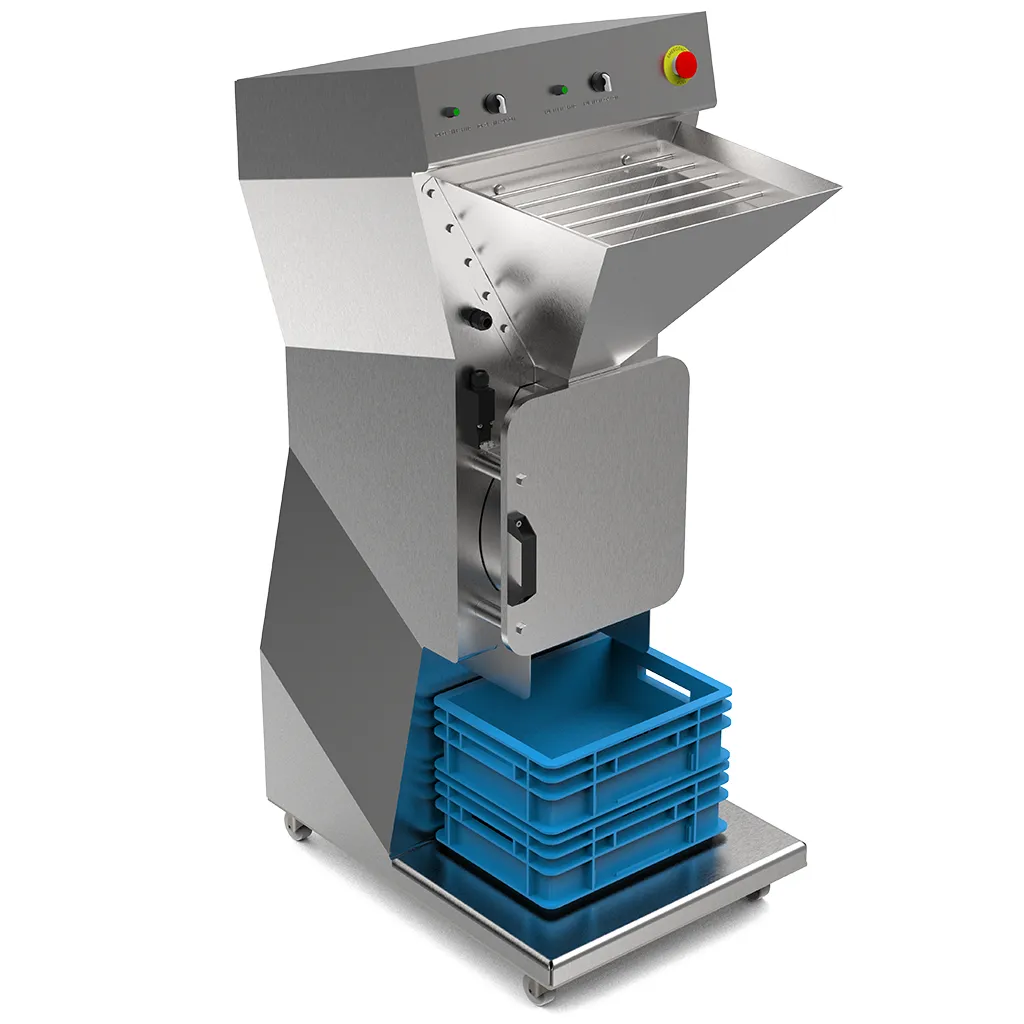 CNG50
CNG50

Standalone or pre-grinder: choose one
Standalone use — output at ~300 µm. For cocoa liquor, rustic nut butters, chunky praline bases, and textured spread bases where chocolate-grade fineness is not required. Output is pumpable and feeds a storage tank or depositor directly. If your downstream process requires a smooth paste below 100 µm, standalone CNG50 output will not meet that specification — a ball mill is required to continue refining.
Pre-grinder before ball mill — final output at 18–25 µm. CNG50 paste feeds directly into the ball mill inlet. Pre-grinding lowers the mechanical load on the grinding media and reduces total ball mill cycle time. Feeding nibs or whole roasted nuts directly into a ball mill without pre-grinding forces the mill to do coarse work it is not rated for — this stalls the circulation pump, extends cycle time, increases media wear, and raises energy consumption per batch.
Cocoa Nib Grinder vs Roasted Nut Chopper: which nut machine do you need
Both machines process roasted nuts. They produce fundamentally different outputs and serve different positions in the line. Selecting the wrong one means buying the other afterwards.
| Property | CNG50 Cocoa Nib Grinder | BCM400 Nut Chopping Machine |
|---|---|---|
| Output form | Fluid paste (fat released) | Dry granules (fat intact, free-flowing) |
| Output particle size | ~300 µm paste | Calibrated granules in 4 sieve fractions |
| Cutting mechanism | Impact and shear (pin mill) — releases fat | Guillotine cutting — preserves granule geometry, minimal fat release |
| Capacity | Up to 50 kg/h | 200–400 kg/h |
| Feeds into | Ball mill refiner or storage tank | Inclusion mixer or ball mill refiner (fine fractions only) |
| Suitable for cocoa nibs | Yes — primary use case | No — nibs are too small and brittle for guillotine cutting |
| Suitable for whole roasted nuts | Yes — hazelnuts, peanuts, almonds, pistachios | Yes — peanuts, hazelnuts, almonds, pistachios, cashews, walnuts |
| Eliminates if… | You need calibrated dry granules for chocolate inclusions or bakery toppings | You need paste — cocoa liquor, smooth nut butter, or ball mill pre-grind |
Cocoa nib grinder vs ball mill: complementary, not interchangeable
The CNG50 accepts roasted solids and produces paste. The ball mill accepts paste and refines it to 18–25 µm. Neither machine substitutes for the other. A ball mill cannot process nibs or whole nuts — dry solids will not circulate through the grinding bead bed and will stall the circulation pump. A nib grinder cannot refine paste to chocolate-grade fineness — 300 µm is its working output. Using both in sequence eliminates that constraint: CNG50 handles paste formation, ball mill handles final texture.
Cocoa nib grinder position in the production line
The CNG50 sits between the roaster/winnower and the ball mill or storage tank. On a bean-to-bar chocolate line: roaster → cracker and winnower → CNG50 → ball mill → conche → tempering. On a nut paste or spread line: roaster → CNG50 → storage tank or depositor, with ball mill finishing added where smooth texture is required. Nuts must be roasted and dry. Raw or unroasted material does not transition reliably to paste under impact grinding and will block the pin chamber.
Maintenance, Cleaning, and Warranty
Cleaning: All product-contact parts are AISI 304 stainless steel. The impact process releases fat, so the chamber holds thick paste after a run. Flush with warm cocoa butter to dissolve residual solids, then wipe down. Do not wash the chamber with water — water seizes the fat-bearing paste and does not clear it.
Warranty & lead time: The CNG50 carries a 1-year warranty against manufacturing and construction defects. Lead time is 3–4 months from order.
CNG50 Cocoa Nib Grinder & Nut Paste Machine – Technical Features
Two-stage impact mill for cocoa nibs and roasted nuts. Top crusher normalises fragment size; pin grinding chamber releases fat and forms paste. Produces pumpable paste at ~300 µm for direct use or ball mill pre-grinding. Runs on 380 V three-phase. Not suitable for raw or unroasted material, calibrated dry granule output, or single-phase supply.
Base Price 13.000,00 € (excl. VAT), EXW Istanbul
Optional devices and export packaging are not included in the base price.
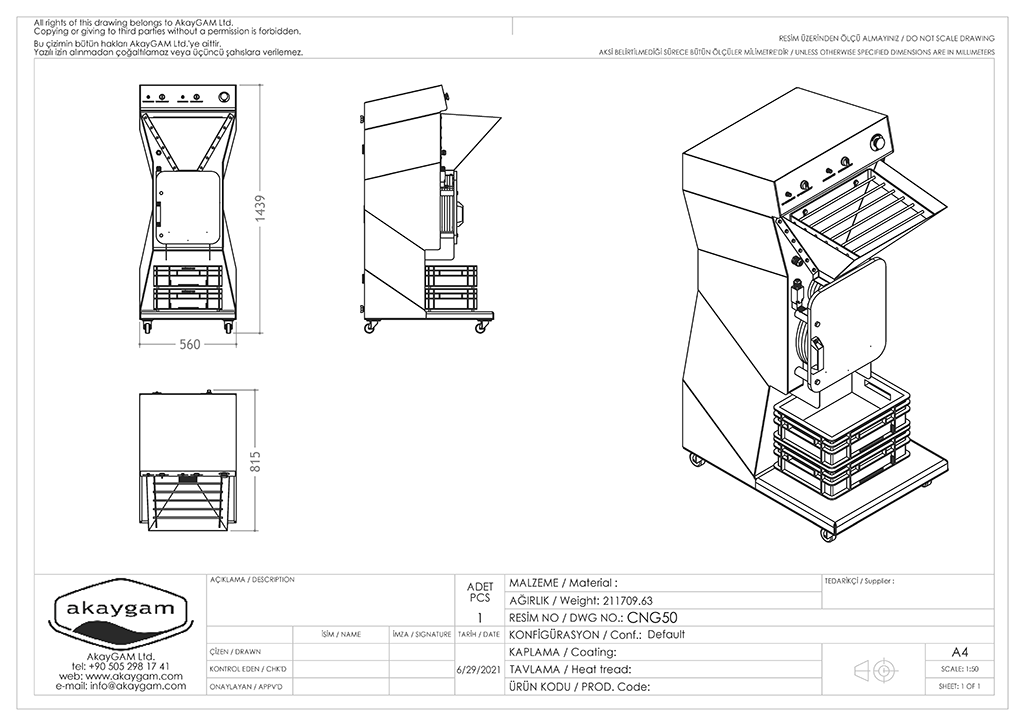
CNG50 Cocoa Nib Grinder – Technical Drawing
Related equipment
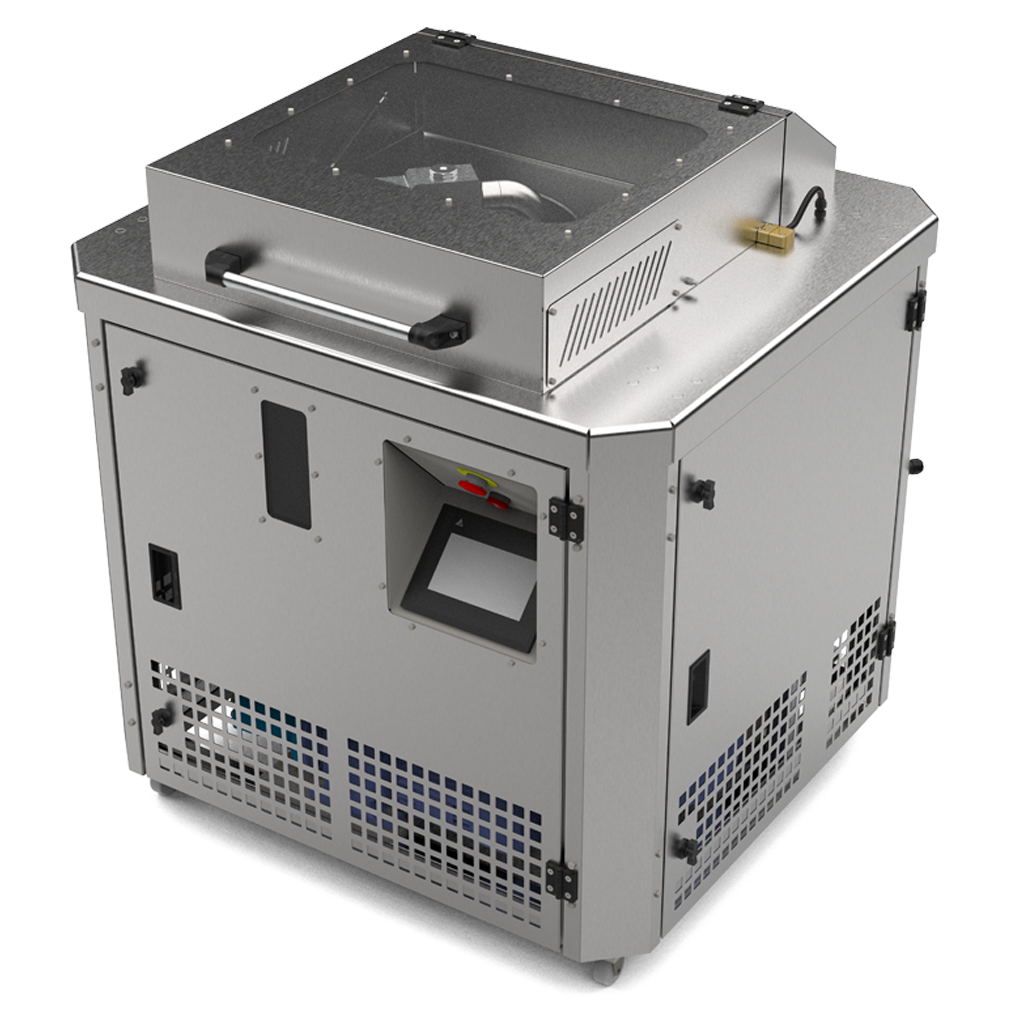
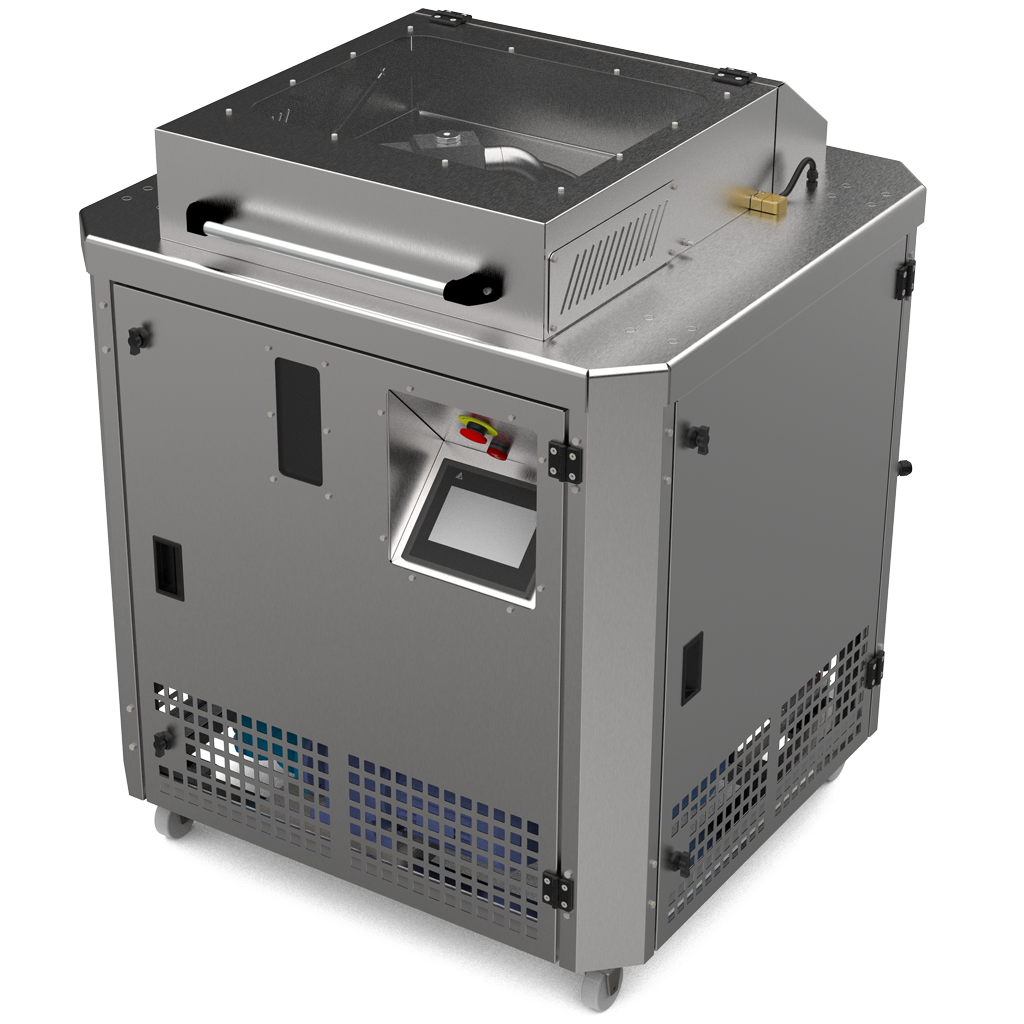
The CNG50 output feeds directly into a ball mill refiner when chocolate-grade fineness (18–25 µm) is required. Pre-grinding with the CNG50 before the ball mill reduces total refining time and lowers the heat load on the ball mill. Four ball mill models cover the range — LabBM10, RBM40, RBM80, and RBM160 — from laboratory through industrial throughput.


Frequently Asked Questions
Answers to common questions about the AkayGAM CNG50 cocoa nib grinder.
What materials can the CNG50 grind?
The CNG50 handles materials with high natural fat content that release oil under impact:
What particle size does the CNG50 achieve?
Under typical conditions with cocoa nibs or roasted hazelnuts, the CNG50 produces paste at approximately 300 µm. The exact figure depends on raw material, roast level, and pin speed setting. This output suits direct use where pre-refined texture is acceptable. For chocolate-grade smoothness or premium spreads, the output feeds a ball mill refiner for reduction to 18–25 µm. The CNG50 alone cannot reach that fineness — it is a paste-formation machine, not a refiner.
Does the CNG50 work as a standalone unit, or does it require a ball mill?
Both, depending on required output fineness:
The CNG50 alone cannot reach chocolate-grade fineness — it is a paste-formation machine, not a refiner.
What is the difference between a cocoa nib grinder and a ball mill?
A cocoa nib grinder processes roasted solids into paste by releasing natural fat through impact and shear. A ball mill refines that paste further using thousands of circulating steel beads, reducing particle size from ~300 µm to 18–25 µm. The two machines are complementary and work in sequence. A ball mill cannot accept nibs or whole nuts as input — dry solids will not circulate through the bead bed and will stall the pump. A nib grinder cannot refine paste to chocolate-grade fineness. Attempting to skip the nib grinder and feed nibs directly into a ball mill will damage the pump and halt production.
What is the production capacity of the CNG50?
Up to 50 kg/h. The 15-litre onboard reservoir buffers the feed and supports continuous operation without constant manual intervention. Actual throughput depends on raw material and target paste consistency. Match CNG50 throughput to the ball mill's feed requirement — running the CNG50 faster than the ball mill can consume will cause paste to accumulate and overflow the ball mill inlet.
What are the electrical requirements for the CNG50?
The CNG50 requires 380 V three-phase. Total installed power is 3.75 kW. No single-phase configuration is available. If your facility does not have three-phase supply, the CNG50 cannot operate — confirm supply compatibility before ordering. If you operate on a voltage or frequency standard different from 380 V / 50 Hz, contact us before ordering to confirm compatibility.
What material is the CNG50 machine made from?
All product-contact parts — including the body, the top crusher rollers, and the pin grinding disc — are made from AISI 304 grade stainless steel. The front lid is fitted with a safety interlock switch that stops the machine if opened during operation.
What maintenance, cleaning, and warranty does the CNG50 need?
Warranty: 1 year against manufacturing and construction defects. Lead time: 3–4 months from order.