
Chocolate Cooling Tunnel
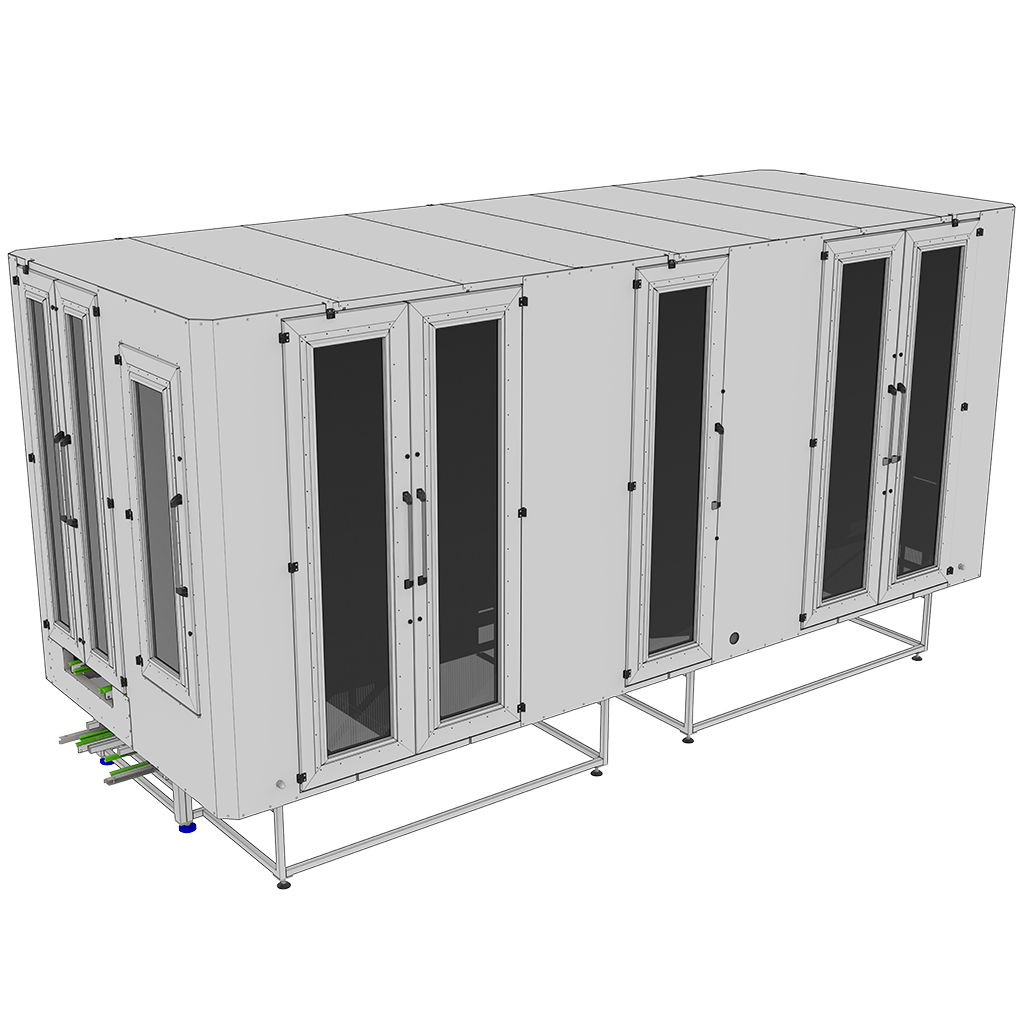
The cooling tunnel sets crystals that the tempering machine formed. It sits downstream of the deposit or enrobing step and discharges set pieces for demolding, packaging, or further processing. Four chassis families plus multi-storey cover molded and belt-deposited production: ETCTA and ETCTI elevators, CTA and CTI horizontal, and multi-storey. Multi-storey sits between horizontal and elevator on both length and height, does not have its own product code yet, and is built on the principle of the cooling loop used in the MMEL100 mini molding line. Plant-engineered configurations beyond these standard chassis are available on request.
VIDEOModel Selection: First Decision
Product format determines the conveyor. Site geometry determines the chassis. Mold footprint determines the elevator family.
Enrobed products and belt-deposited drops, coins, callets → CTA or CTI with PU belt. Pieces release cleanly without sticking. Length is the hard switch: CTA covers tunnels 4–12 m with belt widths 300–800 mm for workshop and small-production scale; CTI covers tunnels 12–30 m with belt widths 600–2000 mm for industrial scale. The 600–800 mm belt-width band overlaps both families — production scale decides. Picking an elevator chassis here fails — ETCTA and ETCTI are mold-only and have no continuous belt surface.
Molded chocolates → ETCTA or ETCTI elevator, CTA / CTI with rod or modular belt, or multi-storey. Molds need direct cold airflow underneath each cavity. Choose the elevator when floor length is restricted but ceiling clearance is available — saves up to 80% of horizontal length; within elevator, ETCTA fits 175×275 mm molds at 108 / 144 / 180 capacity for artisan and small molding lines, ETCTI fits 205×600 mm molds at higher capacity for industrial molding lines. Choose horizontal CTA or CTI with rod or modular belt when ceiling clearance is restricted but floor length is available. Choose multi-storey when both axes are partially constrained and the production is artisan-scale; multi-storey is the only chassis that combines mold cooling with a PU belt section in one machine, capped at 50 kg/h enrobing throughput.
Share
 ETCTA
ETCTA
 CTA
CTA
 CTI
CTI
 ETCTI
ETCTI
Conveyor comparison: PU belt vs rod / modular belt
Conveyor selection follows what runs on it. Polyurethane belt suits enrobed products and belt-deposited drops, coins, and callets — pieces release cleanly without sticking. Rod or modular belt is required for cooling molded chocolate — molds rest on the conveyor surface and need direct cold airflow underneath each cavity. Conveyor type is configured at the order against the product format. Full reasoning in FAQ Q2.
| Product format | Conveyor | Eliminates if… |
|---|---|---|
| Enrobed products, belt-deposited drops, coins, callets | Polyurethane belt | Production is molded chocolates — molds need direct cold airflow underneath each cavity, which a continuous PU belt does not provide |
| Molded chocolates | Rod conveyor or modular belt | Production is enrobed pieces or loose belt-deposited drops/coins/callets — they fall through rod gaps or sit poorly on perforated modular belt |
Chassis comparison: horizontal vs elevator vs multi-storey
Mold cooling can run on a horizontal chassis with rod or modular belt conveyor, on an elevator chassis (ETCTA or ETCTI), or on a multi-storey configuration. All deliver equivalent residence time. The chassis is set by which axis of the installation is constrained — floor length, ceiling height, or both. Within elevator, the family is set by mold footprint. Multi-storey is artisan-scale only. Full reasoning in FAQ Q3.
| Chassis | Length footprint | Ceiling height | Eliminates if… |
|---|---|---|---|
| Horizontal (CTA or CTI with rod / modular belt conveyor) | Long | Standard | Floor length is constrained — the tunnel cannot fit at full residence-time length |
| Elevator artisan (ETCTA — 175×275 mm mold, 108 / 144 / 180 capacity) | Compact (up to 80% length saving vs horizontal) | Tall ceiling required (18-stage vertical loop) | Mold footprint is 205×600 mm or molding line is industrial-scale — chassis cavity does not accept the larger mold; use ETCTI |
| Elevator industrial (ETCTI — 205×600 mm mold, capacity sized at order) | Compact (up to 80% length saving vs horizontal) | Tall ceiling required (29-stage vertical loop) | Mold footprint is 175×275 mm or molding line is artisan-scale — wastes elevator volume and the larger refrigeration load; use ETCTA |
| Multi-storey (no fixed product code; built on the MML100 cooling-loop principle) | Between horizontal and elevator | Between horizontal and elevator | Production is industrial-scale — multi-storey is artisan only and the elevator or horizontal chassis is required for higher capacity |
Elevator family comparison: ETCTA vs ETCTI
For elevator chassis, mold footprint and capacity set the family split. What differs is stage count, mold-handling cavity, and refrigeration sizing; cabinet construction (AISI 304, CFC-free insulation, evaporator and condenser, rodless pneumatic transfer at the top) is common to both. Code structure: ETCT + mold long side (mm) + capacity — for example, ETCT275108 = 175×275 mm mold, 108 mold capacity. Full reasoning in FAQ Q5.
| Family | Mold footprint | Vertical stages | Capacity range | Power | Eliminates if… |
|---|---|---|---|---|---|
| ETCTA (artisan; e.g. ETCT275108, ETCT275144, ETCT275180) | 175×275 mm | 18 | 108 / 144 / 180 molds | 8.5 kW | Molding line uses 205×600 mm molds — chassis cavity does not accept the larger mold footprint |
| ETCTI (industrial; e.g. ETCT600200, ETCT600500) | 205×600 mm | 29 | Sized at order; power scales with mold capacity | Typical 10.5 kW; scales with capacity | Molding line uses 175×275 mm molds at artisan-scale capacity — wastes elevator volume and the larger refrigeration load |
Combined-chassis comparison: multi-storey vs separate chassis
The horizontal chassis (CTA / CTI) ships with one conveyor type at order — either PU belt or rod / modular — and that selection is fixed once the chassis is built. The elevator chassis (ETCTA and ETCTI) are mold-only. Multi-storey is the only chassis where a PU belt section can be added alongside the mold-cooling section, so one machine cools both molded products and enrobed pieces. Trade-off: the combination is artisan-scale only — the enrobing belt caps at 50 kg/h, and beyond that throughput a separate CTA or CTI enrobing tunnel is required. Full reasoning in FAQ Q4.
| Production need | Option | Eliminates if… |
|---|---|---|
| Molded only | Horizontal, elevator, or multi-storey (per chassis decision above) | Production includes enrobed pieces — combined chassis or separate enrobing tunnel is required |
| Enrobed only | CTA or CTI with PU belt (per scale decision below) | Production includes molded chocolates — separate chassis or combined multi-storey is required |
| Both molded and enrobed in one chassis | Multi-storey with mold section and PU belt section | Enrobing throughput exceeds 50 kg/h — multi-storey enrobing belt cannot scale further; run two separate chassis instead |
Model comparison: CTA vs CTI
For belt-deposited production on a horizontal PU belt chassis, length is the hard switch and belt width covers a partly overlapping envelope. What differs is belt and length envelope plus refrigeration sizing; cabinet construction and refrigeration components are common to both. Full reasoning in FAQ Q6.
| Model | Length | Belt width | Eliminates if… |
|---|---|---|---|
| CTA (artisan) | 4–12 m | 300–800 mm | Tunnel length must exceed 12 m — single-pass residence time cannot be reached at the artisan refrigeration sizing; or belt must exceed 800 mm |
| CTI (industrial) | 12–30 m | 600–2000 mm | Tunnel length is 12 m or shorter — wastes belt area and the larger refrigeration load; or belt is below 600 mm |
Belt-width overlap (600–800 mm): production scale decides. Artisan or small-production scale uses CTA; industrial scale uses CTI. Tunnel length is the hard elimination axis — at or below 12 m the answer is CTA, above 12 m the answer is CTI, regardless of belt width.
Warranty and Lead Time
AkayGAM cooling tunnels carry a 1-year warranty against manufacturing and construction defects. Lead time is 3–4 months from order, as length, belt width or mold capacity, conveyor type, and refrigeration sizing are built to the line's longest-cycle product.
Model Specifications
Common to all models
Tab specifications below show only what differs between models or is optional.
ETCTA Elevator Artisan Chocolate Cooling Tunnel – Technical Features
Role: molded-chocolate cooling on artisan and small molding lines where floor length is constrained. Switch to ETCTI for 205×600 mm molds or industrial capacity; switch to CTA or CTI for belt-deposited products. 380 V three-phase.
Price Contact us for pricing
Export packaging is not included in the base price.
Mold capacity (108 / 144 / 180), overhead clearance, and integration with the molding-line depositor and demolding station are confirmed at quotation.
ETCTA Technical Drawing

CTA Horizontal Artisan Chocolate Cooling Tunnel – Technical Features
Role: belt-deposited and enrobed cooling at workshop and small-production scale. Switch to CTI above 12 m tunnel length; switch to ETCTA or ETCTI for molded production where floor length is constrained. 380 V three-phase.
Price Contact us for pricing
Export packaging is not included in the base price.
Tunnel length, belt width, infeed and outfeed integration with the depositor or enrober, and refrigeration sizing are confirmed at quotation.
CTA Technical Drawing

CTI Industrial Chocolate Cooling Tunnel – Technical Features
Role: belt-deposited and enrobed cooling at industrial scale. Switch to CTA at or below 12 m tunnel length; switch to ETCTI for industrial molded production where floor length is constrained. 380 V three-phase.
Price Contact us for pricing
Export packaging is not included in the base price.
Tunnel length, belt width, infeed and outfeed integration with the depositor or enrober, and refrigeration sizing are confirmed at quotation.
CTI Technical Drawing

ETCTI Elevator Industrial Chocolate Cooling Tunnel – Technical Features
Role: molded-chocolate cooling on industrial molding lines where floor length is constrained. Switch to ETCTA for 175×275 mm molds at artisan capacity; switch to CTA or CTI for belt-deposited products. 380 V three-phase.
Price Contact us for pricing
Export packaging is not included in the base price.
Mold capacity, overhead clearance, refrigeration sizing, and integration with the molding-line depositor and demolding station are confirmed at quotation.
ETCTI Technical Drawing
Related equipment
The cooling tunnel sits downstream of the deposit or enrobing step on the production line. Upstream of ETCTA and ETCTI is the depositor on a molding line — a one-shot depositor on a molded-chocolate line, or a semi-automatic molding machine with bundled cooling. Upstream of CTA and CTI is a chocolate enrober, a chocolate drop line for drops/chips/buttons, or a chocolate lentil forming machine for shaped lentils. Chocolate must arrive already tempered — feeding untempered chocolate produces pieces without gloss, lacking snap, and with poor mold or belt release. Downstream of ETCTA and ETCTI is mold demolding; downstream of CTA and CTI is bulk collection, packaging, or further processing such as panning on a coating pan.

Frequently Asked Questions
Answers to common questions about AkayGAM chocolate cooling tunnels.
ETCTA, ETCTI, CTA, or CTI — which model?
Four sequential decisions narrow the choice:
Conveyor type — PU belt, rod, or modular belt?
Product format decides:
CTA and CTI ship with PU belt by default but can be configured at order with rod or modular belt for mold cooling. ETCTA and ETCTI are mold-only by design. Conveyor type is fixed at order against the product format and is not field-changeable once the chassis is built.
Chassis type for molded production — horizontal, elevator, or multi-storey?
All three deliver equivalent residence time; floor area, ceiling height, and capacity decide:
Picking elevator without verifying overhead clearance produces an installation that does not fit; picking horizontal without floor length wastes plant area; picking multi-storey for industrial-scale production hits the capacity ceiling.
Combined molded + enrobed in one chassis — when does multi-storey work?
Multi-storey is the only chassis where a PU belt section can run alongside the mold-cooling section, so one machine handles both. The horizontal CTA/CTI ships with one conveyor type fixed at order; ETCTA and ETCTI are mold-only.
ETCTA or ETCTI — when does the artisan elevator run out?
Mold footprint decides. ETCTA covers 175×275 mm molds at capacities 108 / 144 / 180 — sized for artisan and small molding lines that run molds in the 175×275 mm format. 18 vertical stages, total power 8.5 kW. ETCTI covers 205×600 mm molds at higher capacities — sized for industrial molding lines that run wider, longer molds; 29 vertical stages, capacity and power scale with chassis size (typical 10.5 kW) and are confirmed at order. Picking ETCTA on an industrial molding line with 205×600 mm molds fails — the artisan chassis cavity does not accept the larger mold footprint; picking ETCTI on an artisan line with 175×275 mm molds wastes elevator volume and the larger refrigeration load. The two share construction (AISI 304, CFC-free insulation, evaporator and condenser, rodless pneumatic transfer at the top) — what differs is stage count, mold-handling cavity, and refrigeration sizing.
CTA or CTI — when does the artisan model run out?
Length is the hard switch; belt width covers a partly overlapping envelope. CTA covers tunnels 4–12 m with belt widths 300–800 mm — sized for workshop and small-production enrobing lines, drops/coins/callets at modest throughput. CTI covers tunnels 12–30 m with belt widths 600–2000 mm — sized for industrial enrobing lines, wide-belt drop production, and high-capacity callet output. Belt widths 600–800 mm fall in both families: production scale decides — artisan or small-production scale uses CTA, industrial scale uses CTI. Picking CTA for a tunnel longer than 12 m fails — single-pass residence time cannot be reached at the artisan refrigeration sizing; picking CTI for a 4–12 m artisan setup wastes belt area and the larger refrigeration load. The two share cabinet construction and refrigeration components — what differs is belt and length envelope plus refrigeration sizing.
How is residence time sized?
Residence time is the dwell inside the cooling tunnel from infeed to discharge — the time available for the chocolate to set. Sizing depends on product mass per piece, deposit or mold cavity depth, infeed temperature, and the cooling-zone air temperature profile. Drops and chips solidify quickly because each piece is small; molded pieces need longer because the core cools by conduction through the mold wall; thick enrobed centers need longer still because solidification depth grows as the square root of time. Undersized residence time discharges soft pieces — they deform on collection or stick to the next piece on the belt, or release poorly from the mold. The tunnel is sized at the order against the longest-cycle product the line will run; recipe recall on the line PLC handles changeover within that envelope.
What feeds and discharges the cooling tunnel?
Upstream of the cooling tunnel is the deposit or enrobing step: a one-shot depositor on a molding line for ETCTA or ETCTI, or for CTA and CTI fitted with rod or modular belt; a chocolate enrober or drop-line depositor for CTA and CTI with the default PU belt. Chocolate must arrive already tempered — the cooling tunnel sets crystals that the temperer formed; it does not temper. Feeding untempered chocolate produces pieces without gloss, lacking snap, and with poor mold release or belt release. Downstream, ETCTA and ETCTI discharge molds at conveyor level for demolding; CTA and CTI in the mold-cooling configuration discharge molds at the end of the belt for demolding; CTA and CTI in the PU belt configuration discharge loose pieces for bulk collection, packaging, or further processing such as panning.
What is the warranty and lead time on AkayGAM cooling tunnels?
1 year against manufacturing and construction defects. Lead time is 3–4 months from order, as length, belt width or mold capacity, conveyor type, and refrigeration sizing are built to the line's longest-cycle product.